Introduction
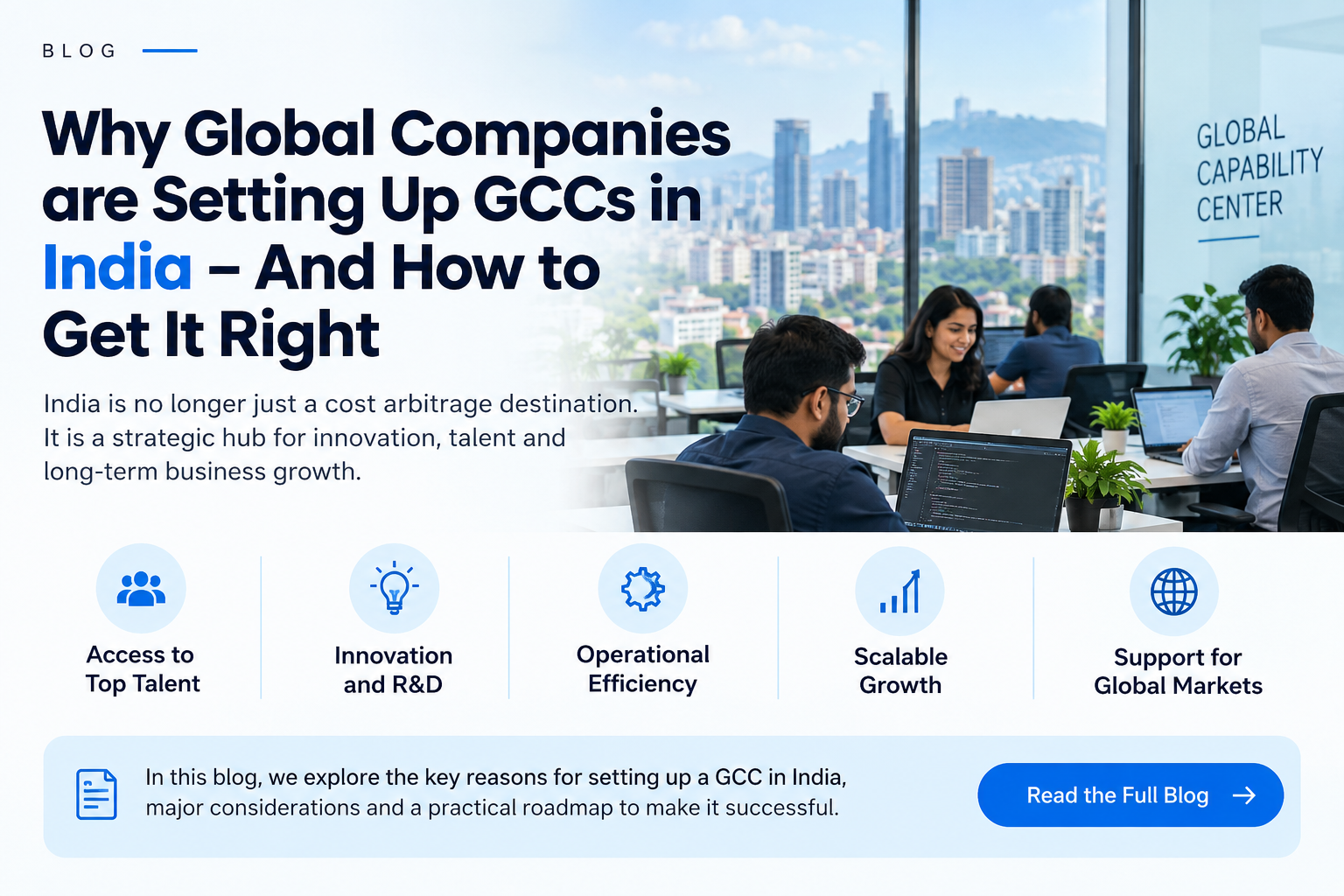
India is no longer just a destination for cost-effective outsourcing. It is becoming a strategic hub for global innovation, technology development, and business transformation.
For companies in the United States, the United Kingdom, Europe, and other global markets, establishing a Global Capability Center (GCC) in India offers an opportunity to access skilled talent, accelerate digital transformation, and build long-term technology capabilities.
However, setting up a GCC requires more than hiring a team and opening an office. Success depends on choosing the right operating model, defining responsibilities, building reliable processes, and selecting the right technology partner.
In this blog, we explore why India has become an attractive destination for GCCs, the challenges companies face, and how businesses can establish a successful GCC with the right strategy.
What Is a Global Capability Center (GCC)?
A Global Capability Center is an offshore or international center established by a company to manage and deliver strategic business functions for its global operations.
Unlike traditional outsourcing, where an external vendor performs a defined service, a GCC typically operates as an extension of the parent organization.
Depending on the company's requirements, a GCC can manage :
- Software development and product engineering
- Cloud infrastructure and DevOps
- Data engineering, analytics, and artificial intelligence
- Quality assurance and software testing
- Enterprise application development
- Cybersecurity and IT operations
- Business process management and technical support
A well-designed GCC gives a company greater control over its technology roadmap, talent development, intellectual property, and long-term operational capabilities.
Why Are Global Companies Choosing India for GCCs?
1. Access to a Large Technology Talent Pool
India has a substantial technology workforce with experience across modern software development frameworks, cloud platforms, enterprise applications, data engineering, and emerging technologies.
For companies struggling to recruit technical talent in their domestic markets, an Indian GCC can provide access to specialized skills and dedicated engineering teams.
The key is not simply hiring more people. It is building a team with the right technical capabilities, communication skills, ownership, and delivery discipline.
2. Cost Efficiency Without Compromising Capability
Recruiting and retaining technology professionals in major US and UK markets can be expensive. Establishing a GCC in India can help companies optimize operating costs while developing strong internal technology capabilities.
However, cost savings should not be evaluated using salary differences alone. Companies must also consider recruitment, infrastructure, compliance, management, employee retention, and operational overheads.
The objective should be better business value, not simply cheaper resources.
3. Faster Product Development and Innovation
A GCC can become a core engineering hub responsible for building, testing, maintaining, and enhancing enterprise products.
For example, a UK-based SaaS company could establish an Indian engineering team to manage backend development, frontend engineering, automated testing, and cloud deployment.
With clear ownership and strong engineering processes, the company can increase development capacity and reduce its dependence on ad hoc external resources.
4. Greater Control Over Technology and Intellectual Property
When designed with appropriate legal agreements, access controls, and security policies, a GCC can help companies retain stronger control over their source code, technical knowledge, development processes, and product roadmap.
Companies should establish clear IP ownership, confidentiality obligations, repository permissions, and data-handling procedures from the beginning.
5. Long-Term Operational Scalability
A company may initially require a small software engineering team. As its product portfolio grows, it may expand into cloud engineering, data analytics, application support, and dedicated product teams.
A GCC provides a structure for scaling these capabilities over time and developing a stable technology organization aligned with long-term business objectives.
GCC vs. Traditional Outsourcing: What Is the Difference?
| Factor | Traditional Outsourcing | GCC Model |
|---|---|---|
| Primary objective | Deliver defined services | Build long-term internal capabilities |
| Operating structure | External service provider | Center aligned with the parent company |
| Governance | Contract and service-level driven | Parent-company strategy and governance |
| Knowledge retention | Depends on vendor arrangements | Designed for continuity within the organization |
| Long-term role | Execution of contracted work | Engineering, innovation, operations, and strategic functions |
The two models are not mutually exclusive. Some companies use a hybrid approach, combining an internal GCC with external technology partners to establish capabilities faster and manage specialized workloads.
The Five Major Challenges in Setting Up a GCC in India
1. Choosing the Right Operating Model
Companies must decide whether to establish a wholly owned entity, work with an established GCC partner, or use a build-operate-transfer arrangement. Each approach has different implications for control, cost, compliance, speed, and long-term ownership.
2. Recruiting the Right Team
A GCC can struggle even when recruitment targets are met. Companies should establish competency matrices, structured interviews, onboarding plans, reporting structures, and performance measures before scaling the workforce.
3. Establishing Strong Engineering Processes
A team cannot deliver consistently without documented development standards. Essential practices include code reviews, version control, automated testing, release management, incident tracking, documentation, and security reviews.
4. Managing Communication Across Time Zones
Teams working across India, the US, and the UK need clear communication protocols. Documented requirements, agreed overlap hours, transparent project tracking, and defined escalation procedures reduce delays and misunderstandings.
5. Building Security and Compliance Into Operations
Companies must address data protection, contractual obligations, access management, IP protection, regulatory requirements, and relevant industry standards. Legal, HR, finance, and information-security teams should be involved early in the setup process.
A Practical Roadmap for Setting Up a GCC in India
Phase 1 : Define the business case. Identify the functions to establish in India, expected outcomes, initial investment, target operating costs, and long-term expansion plans.
Phase 2 : Select the location and operating model. Evaluate talent availability, infrastructure, business ecosystem, operating costs, compliance requirements, and access to leadership.
Phase 3 : Start with a focused team. Begin with a clearly defined scope and a small team where practical. A technology-focused team might include developers, QA engineers, and a technical lead.
Phase 4 : Establish governance and delivery standards. Define reporting structures, project ownership, development workflows, security controls, documentation standards, and measurable performance indicators.
Phase 5 : Scale based on results. Expand into additional engineering, data, cloud, product, or support functions after the initial team demonstrates consistent delivery and business value.
The exact timeline depends on the legal structure, hiring requirements, infrastructure, and scope of operations.
How Krezora Can Support Companies Building Technology Capabilities in India?
For companies that want to establish or expand their technology presence in India, Krezora offers a technology-services-led approach to building delivery capabilities.
As the technology services arm of VM EDULIFE Pvt. Ltd., Krezora focuses on helping businesses access software engineering expertise and structured technology delivery.
Its services include:
- Software Development : Custom web applications, enterprise software, and business platforms.
- Product Engineering : Product enhancement, feature development, and engineering support.
- Cloud and DevOps : Infrastructure automation, deployment workflows, monitoring, and cloud operations.
- Data and Analytics : Data processing, reporting solutions, and analytics capabilities.
- Application Support and Enhancement : Ongoing maintenance, troubleshooting, optimization, and feature improvements.
- IT Consulting : Technical assessments, architecture planning, and technology strategy.
- Managed IT Services : Structured technical operations and ongoing support.
For companies exploring a GCC in India, these capabilities can support an initial technology team, a specialized engineering function, or a broader technology delivery model. The appropriate engagement structure should be defined according to the client's requirements, governance preferences, security needs, and long-term plans.
Why Starting Small Can Be a Smart Strategy?
Establishing a large technology center immediately is not always necessary. A company can begin with a focused team, assign a measurable business objective, and evaluate the results over an initial engagement.
For example, a US-based SaaS business might begin with three developers, one QA engineer, and one technical lead to improve product delivery.
The first phase can measure :
- Delivery predictability
- Code quality and defect rates
- Communication effectiveness
- Documentation and knowledge transfer
- Cost per completed feature
- Ability to work within the company's existing processes
Once the engagement demonstrates value, the company can decide whether to expand the team, establish a more formal GCC structure, or adopt a build-operate-transfer arrangement where appropriate.
Conclusion : Build Capabilities, Not Just an Offshore Team
India's GCC opportunity extends beyond cost reduction. It offers global companies a way to build engineering depth, strengthen technology ownership, improve operational resilience, and support long-term innovation.
However, the success of a GCC depends on the quality of its operating model, people, governance, security, and delivery processes.
Companies that approach GCC setup as a strategic business initiative, rather than simply a recruitment exercise, are better positioned to build sustainable capabilities.
Frequently Asked Questions
What is a GCC in India?
A Global Capability Center is a center established by a company to manage strategic functions such as software engineering, technology operations, analytics, and business services for its global organization.
Why are companies setting up GCCs in India?
Companies consider India for its technology talent pool, potential operating efficiencies, engineering capabilities, and opportunities to build long-term technology teams.
What is the difference between a GCC and outsourcing?
Traditional outsourcing typically involves a third-party provider delivering contracted services. A GCC is generally designed as an extension of the parent company, with closer alignment to its strategy and governance.
Which Indian cities are considered for GCC setup?
Pune, Bengaluru, Hyderabad, Chennai, and other technology hubs may be considered. The right location depends on talent availability, operating costs, infrastructure, and business requirements.
Can a technology partner help before a GCC is fully established?
A technology partner may support software development, product engineering, cloud operations, application support, or specialist delivery needs. The scope depends on the company's operating model and requirements.
Planning to Build Your Technology Capabilities in India?
Discuss your business goals, engineering requirements, and delivery expectations with Krezora to explore a practical path forward.
Discuss Your Requirements